Sapiens: A Brief History of Humankind — Yuval Noah Harari
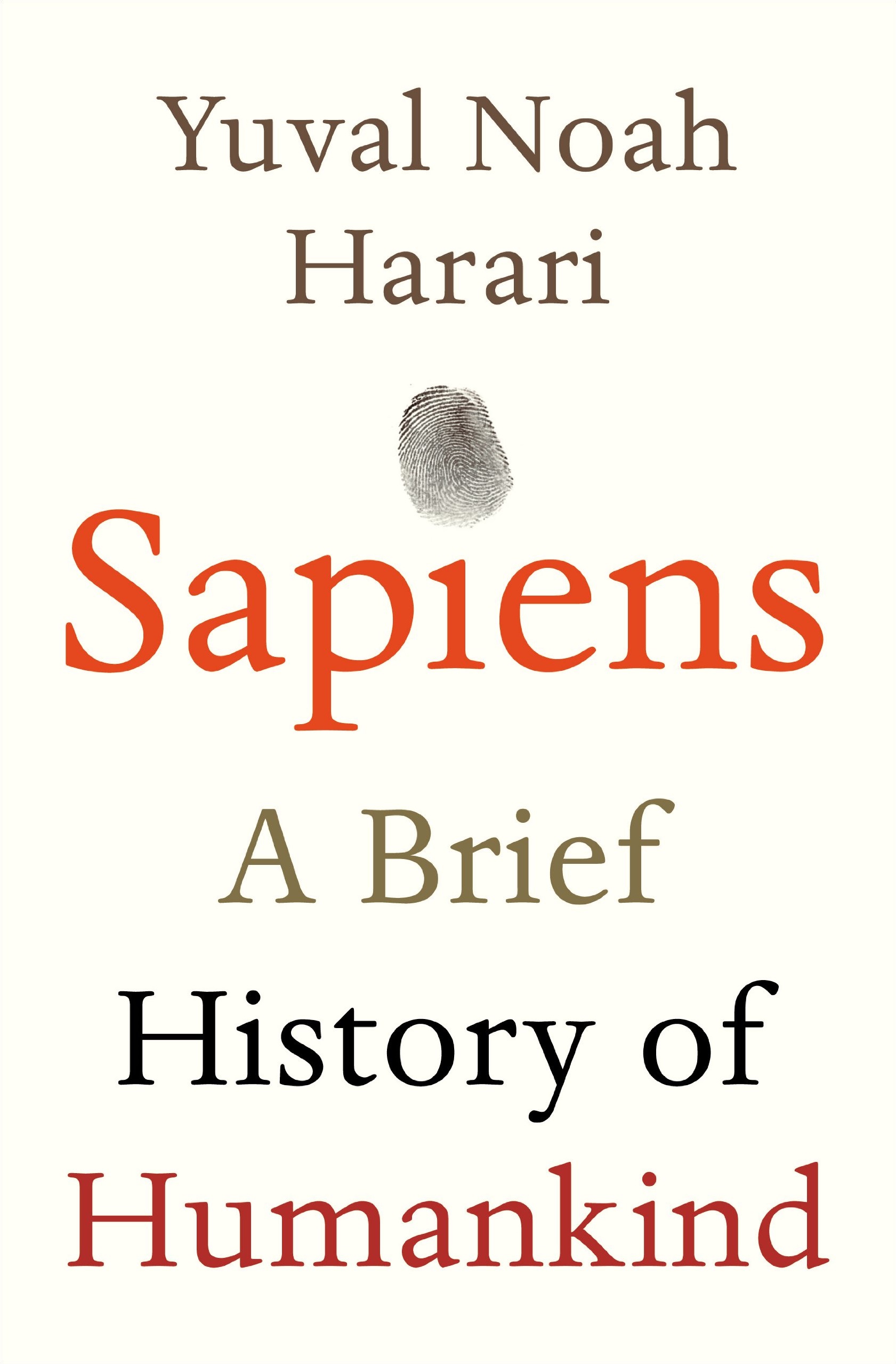
What makes us human? What binds us together? What drives our species forward—and what holds us back?
Harari divides human history into three major revolutions: the Cognitive Revolution (c. 70,000 years ago), the Agricultural Revolution (c. 12,000 years ago), and the Scientific Revolution (c. 500 years ago). Each one reshaped our species in profound ways, not just biologically or socially, but psychologically and spiritually.
The Cognitive Revolution: Imagining Our Way Forward
Harari begins with the idea that Homo sapiens became dominant not because of physical strength or intelligence alone, but because of our ability to believe in shared myths. Religion, money, nations, laws—these are all imagined orders, constructs that exist only because enough people believe in them. This insight reframed my understanding of reality itself. What we call "truth" is often consensus. What we call "progress" is often mythmaking.
This revolution gave birth to storytelling, gossip, and cooperation beyond kinship. It allowed tribes to become nations, and rituals to become religions. Harari’s framing made me question everything I take for granted: Why do I obey laws? Why do I value currency? Why do I feel loyalty to a flag? These aren’t natural instincts—they’re inherited fictions.
The Cognitive Revolution also introduced the idea of collective learning. Unlike other species, humans could accumulate knowledge across generations. This allowed us to build on past discoveries, refine tools, and develop complex cultures. Harari emphasizes that this ability to share and preserve information is what truly sets us apart.
The Agricultural Revolution: A Trap of Our Own Making
Harari calls the Agricultural Revolution "history’s biggest fraud." It’s a provocative claim, but he backs it with unsettling logic. Farming allowed humans to settle, multiply, and build civilizations—but at the cost of freedom, health, and happiness. Early farmers worked harder than foragers, ate worse, and became more vulnerable to famine and disease.
This section made me reflect on the trade-offs of stability. We often equate permanence with progress, but Harari shows how domestication—of plants, animals, and ourselves—led to hierarchy, patriarchy, and suffering. Wheat didn’t domesticate us; we domesticated wheat. And in doing so, we became slaves to our own systems.
It’s a sobering reminder that not all growth is good. Sometimes, the structures we build to protect us become cages.
The Agricultural Revolution also introduced concepts like property, inheritance, and social stratification. As people settled into fixed communities, inequality grew. Landowners emerged, and with them, systems of control and exploitation. Harari argues that this shift laid the groundwork for future empires and economic systems that still shape our lives today.
The Scientific Revolution: Power Without Purpose
The final revolution is the most recent—and the most dangerous. Harari explores how science gave us unprecedented power, but little wisdom. We learned to split atoms, sequence genomes, and manipulate ecosystems—but we still struggle to define meaning, morality, and purpose.
This part of the book felt especially urgent. Harari doesn’t celebrate technology blindly. He warns that without ethical grounding; scientific progress can lead to existential risk. Nuclear war, climate collapse, AI takeover—these aren’t science fiction tropes. They’re plausible futures.
Harari’s critique of capitalism and consumerism also hit hard. He shows how modern humans chase happiness through consumption, yet remain anxious, disconnected, and unfulfilled. We’ve traded gods for brands, rituals for routines, and meaning for dopamine.
The Scientific Revolution also brought about the rise of imperialism. Harari explains how European powers used scientific advancements to justify conquest and colonization. Maps, navigation tools, and medical knowledge became instruments of control. This intersection of science and empire reveals the dark side of progress.
Myth, Meaning, and Fragility
What stayed with me most was Harari’s insistence that humans are fragile storytellers. We build civilizations on shared fictions, and those fictions can vanish overnight. Empires fall. Religions splinter. Economies collapse. What remains is the story we tell ourselves—and whether it still makes sense.
Reading Sapiens made me feel both insignificant and empowered. Insignificant because I’m just one node in a vast, chaotic network of history. Empowered because I can choose which stories to believe, which myths to uphold, and which futures to imagine.
It’s a book that doesn’t offer comfort. It offers clarity. And sometimes, clarity is the most radical gift.
Harari also explores the concept of happiness. Despite all our advancements, are we truly happier than our ancestors? He suggests that while our material conditions have improved, our psychological well-being remains elusive. This paradox challenges the very notion of progress.
Personal Resonance
I read Sapiens after finishing H. G. Wells’ A Short History of the World, and the contrast was striking. Wells gave me a sweeping, romantic timeline. Harari gave me a scalpel. Where Wells saw progress, Harari saw pathology. Where Wells celebrated civilization, Harari interrogated it.
Yet both books helped me understand how we became what we are. They traced the arc of humanity—from cave paintings to space travel—with different lenses. Wells looked outward. Harari looked inward.
Harari’s writing also made me reflect on my own beliefs. What do I consider sacred? What systems do I participate in without questioning? Sapiens encouraged me to examine my values, my habits, and my place in the grand narrative of human history.
Reading Sapiens felt like waking up in a world I thought I understood—and realizing I didn’t.
Legacy and Impact
Since its publication, Sapiens has sparked global conversations. It’s been translated into dozens of languages and read by millions. Its impact goes beyond academia—it’s influenced entrepreneurs, politicians, and everyday readers.
Harari’s ability to distill complex ideas into accessible prose is part of its appeal. He doesn’t shy away from controversy, and he invites readers to think critically. Whether you agree with him or not, Sapiens forces you to confront uncomfortable truths.
The book also serves as a gateway to deeper inquiry. Many readers go on to explore anthropology, philosophy, and history in more depth. It’s a starting point—a provocation, not a conclusion.
Final Thoughts
Sapiens is more than a history book. It’s a mirror, a map, and a challenge. It asks us to reconsider everything we think we know about ourselves. It’s not always comfortable, but it’s always illuminating.
For me, it was a transformative read. It reshaped my understanding of humanity, and it continues to influence how I see the world. In a time of rapid change and uncertainty, Sapiens offers a rare gift: perspective.
Sapiens vs. A Short History of the World
While both Sapiens and A Short History of the World by H. G. Wells aim to chart the journey of humankind; their approaches and tones diverge dramatically.
Wells writes with the optimism of a 20th-century humanist. His narrative is linear, sweeping, and celebratory highlighting the rise of civilizations, the triumph of reason, and the promise of progress. Reading Wells feels like watching humanity ascend a staircase toward enlightenment.
Harari, by contrast, is skeptical, surgical, and provocative. His history is nonlinear, filled with ruptures, contradictions, and uncomfortable truths. He doesn’t just describe what happened—he questions why it happened, who benefited, and what it cost. Reading Harari feels like being handed a mirror and asked, "Do you like what you see?"
Wells offers a comforting story of growth. Harari offers a challenging story of myth and fragility. Yet both are essential. Wells helps us see the arc. Harari helps us question the foundation.
Together, they form a dialogue—between hope and doubt, between narrative and critique. And in that tension, I found a deeper understanding of what it means to be human.
When the world gets loud or the way forward seems unclear, I turn to books that anchor me. This title earned its spot for exactly that reason. Curious about the other 99? Take a look at the full, evolving list:


Comments
Post a Comment